

The Importance of Airway Health from a Young Age
Proper airway health in children from a young age sets the tone for their future health, behavior, and many other aspects of their lives. Many people aren’t familiar with airway health, and airway health problems in kids can often be ignored or misdiagnosed. Airway and oral health is a major component of our orthodontic approach, and we’re happy to educate our patients on the benefits of our non-extraction and non-retraction techniques in improving their airways and breathing.
5 Signs of Poor Airway Health
1. Snoring and Sleep Apnea
Snoring and sleep apnea are the number one signs of poor airway health and possibly even sleep-disordered breathing (SDB). No child at any age should snore. It’s the immediate sign that something isn’t right, and they should be evaluated soon. When you doze off and go from a light sleep to a deep sleep, the muscles in the roof of your mouth (soft palate), tongue, and throat relax. The tissues in your throat can relax enough that they partially block your airway and vibrate. The more narrowed your airway, the more forceful the airflow becomes. This increases tissue vibration, which causes your snoring to grow louder. When you snore, the passageway of airflow to your brain narrows so significantly that you actually get less oxygen to your brain. Snoring is often associated with a sleep disorder called obstructive sleep apnea (OSA). Not all snorers have OSA, but if any of the following symptoms accompany snoring, it may be an indication to come in for an evaluation.
- Witnessed breathing pauses during sleep
- Excessive daytime sleepiness
- Difficulty concentrating
- Morning headaches
- Sore throat upon awakening
- Restless sleep
- Gasping or choking at night
- High blood pressure
- Chest pain at night
- Your snoring is so loud it’s disrupting your partner’s sleep
- In children, poor attention span, behavioral issues, or poor performance in school
If you or your child snore and have any of the additional symptoms listed above, it would be a great opportunity to meet with Dr. Greg for a free airway evaluation.
2. Crowded Teeth

If your child’s permanent teeth don’t have enough room to come in naturally, it could also be a sign of an airway issue. A proper orthodontic and airway evaluation should be done if the new teeth overlap. We focus on non-extraction techniques, so our plan would most likely include a way to grow and widen the palate, which would allow the teeth to have the space they need to straighten out while using braces. Expanding the palate will also naturally increase the airway and eliminate other negative symptoms that come with a crowded mouth.
3. Receding chin
 An underdeveloped lower jaw pushes the tongue back into the throat, blocking the airway. This is caused by the growth pace of the upper and lower jaw not always being in sync. Sometimes, the maxilla (upper jaw) grows faster than the mandible (lower jaw), and vice versa in some cases. Such imbalanced jaw development can result in the chin appearing weak or receding. You can identify a receding chin and a weak/underdeveloped jawline through the following characteristics:
- Poorly defined jawline
- Little to no definition between the neck and the chin
- Short, narrow, or small chin
- Loose skin or wrinkles surrounding the mouth
The solution for a receding chin is typically unique to each case and depends on the underlying cause of the child’s recessed chin. We recommended that children with a receding chin should have their first orthodontic check-up at around age six or seven. Braces and orthodontic treatment for a receding chin tend to be much more successful when the patient is young. Early orthodontic supervision ensures that any insufficient jaw growth contributing to the position of the chin is obstructed; it is also possible to begin guiding the jaw’s growth in a healthy direction at this age. Correcting the jawline and improving the structure of the chin, jaw, and teeth will naturally improve the airway, which will result in improved breathing and health.
An ideal oral posture is keeping your mouth closed, lips shut, molar teeth touching or almost touching, and, most importantly, keeping your entire tongue (even the back) against the roof of your mouth.
4. 24/7 Mouth Breathing
 Mouth breathing can cause crooked teeth, facial deformities, or poor growth in children. In adults, chronic mouth breathing can cause bad breath and gum disease. It can also worsen symptoms of other illnesses. It’s important for a parent to look for signs of mouth breathing because a child may not be able to communicate their symptoms. Like adults, children who are mouth breathers will breathe with their mouths open and will snore at night.
Children who breathe through their mouths for most of the day may also have the following symptoms:
- slower than normal growth rate
- irritability
- increased crying episodes at night
- large tonsils
- dry, cracked lips
- problems concentrating at school
- daytime sleepiness
Children who exhibit problems concentrating at school are often misdiagnosed with attention deficit disorder (ADD) or hyperactivity rather than diagnosing an airway issue. It’s our mission to help spread awareness of sleep-disordered breathing (SDB) and other airway issues.
The underlying cause of most cases of mouth breathing is an obstructed (completely blocked or partially blocked) nasal airway. In other words, there’s something preventing the smooth passage of air into the nose. If your nose is blocked, the body automatically resorts to the only other source that can provide oxygen — your mouth. There are many causes of a blocked nose, including nasal congestion (usually temporary), enlarged tonsils and adenoids, the shape and size of the jaw, deviated septum, and others.
For many parents, mouth breathing isn’t the first thought when they try to figure out their child’s symptoms or bad behavior. Poor airway health and mouth breathing can affect many elements of a child’s daily life.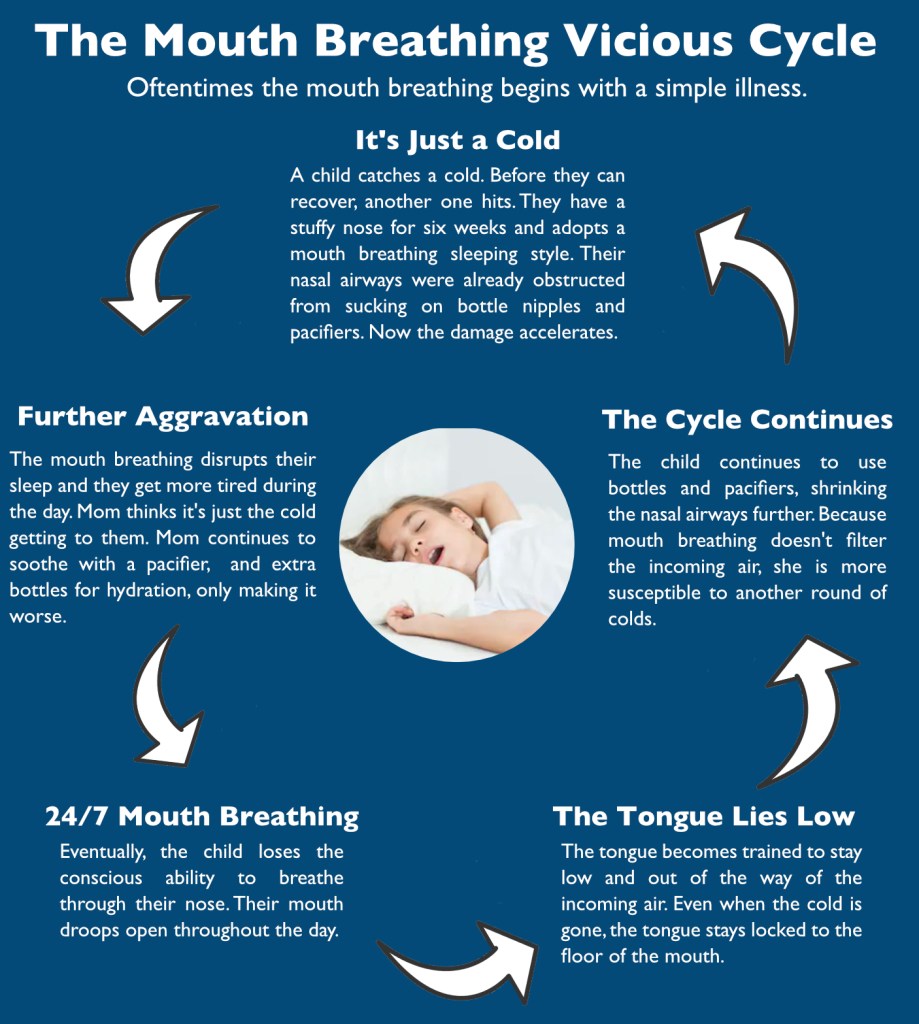
5. Swollen tonsils
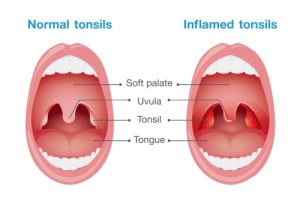 Sometimes, your tonsils or adenoids become infected or enlarged, often staying a larger size that can cause long-term effects. In some people, they can cause frequent bacterial infections; in others, it can be a serious ongoing issue of blocking the airway, making breathing hard. Many kids and adults may naturally try to adapt their breathing techniques, but they are still living with labored breathing and possibly less oxygen in the brain. This is something that needs to be addressed by your dentist, orthodontist, or possibly an ENT. If your adenoids and tonsils are enlarged, you might notice:
- It is hard to breathe through your nose
- It might be hard to sleep
- Your voice sounds like your nose is plugged up
- A runny nose
- Noisy breathing
- Frequent ear infections
- Snoring
- Pauses in your breathing while you sleep
If you or your child thinks that your tonsils may be swollen, ask one of our doctors to examine them at your next visit.
Help Your Child Breath Easy
The doctors at Campi Dental have the knowledge and experience to diagnose and treat oral issues related to disordered breathing. Contact us today to schedule.
Poor Airway Health is Affecting Today’s Youth
An Estimated 9 out of 10 kids suffer from one or more of these chronic conditions:
- ADD/ADHD
- Bedwetting
- Problems in School
- Snoring
- Stunted Growth
- Nightmares
- Lowered IQ
- Night Sweats
- Crowded Teeth
- Crooked Teeth
- Aggression
- Swollen Tonsils
- Anxiety
- Allergies
- Day Sleepiness
- Speeth Problems
Over the past 20 years, research has linked the above conditions to a common cause – Children’s Sleep Disordered Breathing (SDB). SDB causes disruptions in a child’s sleep pattern, which can potentially lead to other long-term health problems. It causes a reduction in the amount of oxygen that a child’s body and brain receive during sleep, and when the child doesn’t receive enough oxygen, it causes many issues, as mentioned above. Children with SDB usually breathe through their mouths 24/7, but even more so at night. Snoring and sleep apnea are often associated with this as well.
It is quite common for parents to overlook minor stunted developments in the case of their children, banking on the fact that it will get better once they get older. Unfortunately, when it comes to dental problems, breathing health, and craniofacial muscle posture, it only worsens as they grow up. It has been statistically proven that nearly 90% of a child’s facial development is done by the age of 12 years. It is especially important to make regular visits to the dentist because any malformations and abnormalities in the facial development get easily detected by professionals, leading to immediate rectification.
Does your child breathe through their mouth? Do they snore? Airway health should not be ignored. If this post makes you think that you or your child could possibly have breathing or airway issues, please schedule a consult to be evaluated.
Comments are closed.